
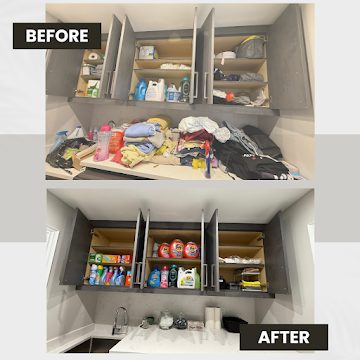
The fastest way to declutter your home is to work one small area at a time, sorting every item into four piles: keep, donate, relocate, and toss, and to do it in short, focused sessions rather than one exhausting marathon. Start with a single drawer or shelf, finish it completely, and let that quick win carry you to the next. Below, we'll walk through the exact process we use with families across the Greater Toronto Area, plus the common mistakes that keep clutter coming back.
We all dream of a home that feels calm and organized. But when clutter piles up, knowing where to start can feel paralyzing. The good news: decluttering is a skill, not a personality trait, and anyone can do it with the right system.
Why decluttering feels so hard (and how to make it easier)
Clutter isn't really about stuff, it's about decisions. Every item asks a small question: keep or let go? Multiply that by a whole house and your brain hits decision fatigue fast. That's why the all-in-one-weekend approach usually ends in burnout and a bigger mess than you started with.
The fix is to shrink the decisions. Work in small zones, set a timer, and follow a repeatable sorting system so you're not reinventing the process every time.
The simple 4-pile decluttering method
For every space you tackle, sort each item into one of four piles:
- Keep: you use it, love it, or genuinely need it.
- Donate: good condition, but no longer serves you.
- Relocate: belongs somewhere else in the home (don't wander off to put it away yet, just pile it).
- Toss / recycle: broken, expired, or beyond use.
Resist the "maybe" pile. If you have to think hard about whether you'd miss it, you usually won't.
How to declutter your home, room by room
You don't have to do it all at once. Pick one area, finish it, then move on. Here's the order we recommend for the best momentum:
1. Start with an easy win (a drawer or shelf). Choose something small you can finish in 15 minutes, your junk drawer, a single shelf, the bathroom cabinet. Completing one space builds the confidence to keep going.
2. Entryway and "drop zones." The spots where keys, mail, shoes and bags land first. Clearing these has an outsized impact because they're the first thing you see every day. Add a basket or tray to catch the daily essentials.
3. Kitchen and pantry. Toss expired food, group similar items, and keep counters as clear as possible. A functional kitchen makes daily life noticeably calmer.
4. Closets and bedrooms. Pull everything out, sort with the 4-pile method, and only return what you actually wear and love. Front-and-centre for daily items, higher or further back for seasonal ones.
5. Bathrooms. Quick and high-impact: clear expired products, corral the rest in simple containers.
6. The big projects: garage, basement, home office. Save these for when you've built momentum, they hold the most "just for now" clutter. (See our full garage organization guide for these.)
The 5 most common decluttering mistakes
After organizing hundreds of GTA homes, these are the traps we see most:
- Starting too big. A whole-house blitz leads to burnout. Small zones win.
- Buying bins before decluttering. Containers organize clutter you've already decided to keep, declutter first, shop second.
- The wandering trap. Carrying one item to another room, then getting distracted there. Use the "relocate" pile instead.
- Keeping things out of guilt. Gifts and "someday" items aren't a debt. If it doesn't serve your life now, it's okay to let it go.
- No plan for the "out" pile. Donations that sit in the trunk for months recreate the clutter. Schedule the drop-off, or work with a pro who hauls it for you.
How to keep your home decluttered for good
Decluttering once is easy to undo. Keeping it requires small, sustainable habits:
- The one-in, one-out rule. New item in, an old one goes out.
- A 10-minute daily reset. Tidy surfaces before bed so clutter never compounds.
- A donation bin in the closet. When something no longer fits your life, it goes straight in.
- Seasonal mini-resets. A quick pass each season keeps things from creeping back.
Simple beats perfect. A system you'll actually maintain on a busy Tuesday is worth more than a flawless one you'll abandon by Friday.
A local note for GTA homes
Many Toronto and York Region homes, especially condos and townhomes, come with limited storage. That makes ruthless decluttering even more valuable: when storage is tight, every item has to earn its place. Going vertical, using the backs of doors, and keeping only what you truly use will make a small space feel dramatically larger.
When to call a professional organizer
Sometimes a space is too big, too emotional, or too long-avoided to tackle alone, and that's completely okay. A professional organizer brings a system, a second set of hands, and zero judgment, which makes starting (the hardest part) far easier. At Chaos Meets Order, we declutter and organize alongside you, then haul away the donations and junk so your space is truly finished. If clutter feels overwhelming, you don't have to do it alone. We help families across Toronto, Vaughan, Markham, Richmond Hill, Aurora and York Region, and we offer ADHD-friendly organizing for brains that find traditional methods harder to stick.
Frequently asked questions
Where should I start decluttering when I feel overwhelmed? Start with one small area you can finish in 15 minutes, like a single drawer or shelf. Completing one space gives you a quick win and the momentum to keep going. Avoid trying to do the whole house at once.
What is the fastest way to declutter a house? Work one small zone at a time and sort every item into four piles, keep, donate, relocate, and toss, in short, focused sessions. Small, finished areas beat long marathons that end in burnout.
How do I decide what to keep? Ask whether you've used or loved the item in the last year. If you have to think hard about whether you'd miss it, you usually won't. Keep what serves your life now, not out of guilt or "someday."
How do I stop clutter from coming back? Use the one-in-one-out rule, do a 10-minute daily reset, keep a donation bin handy, and do quick seasonal mini-resets. Sustainable habits matter more than a single big purge.
Should I declutter or organize first? Always declutter first. Organizing and buying storage before decluttering just rearranges things you may not need. Decide what stays, then create systems for it.
Ready for a calmer, more organized home? If you'd love help making it happen, book a free consultation with Chaos Meets Order. We'll build a plan together, judgment-free.
How to declutter your home without the overwhelm
The simplest way to learn how to declutter your home is to work one small zone at a time with a four-pile system. Once you know how to declutter your home room by room, a few light habits keep it that way for good.